
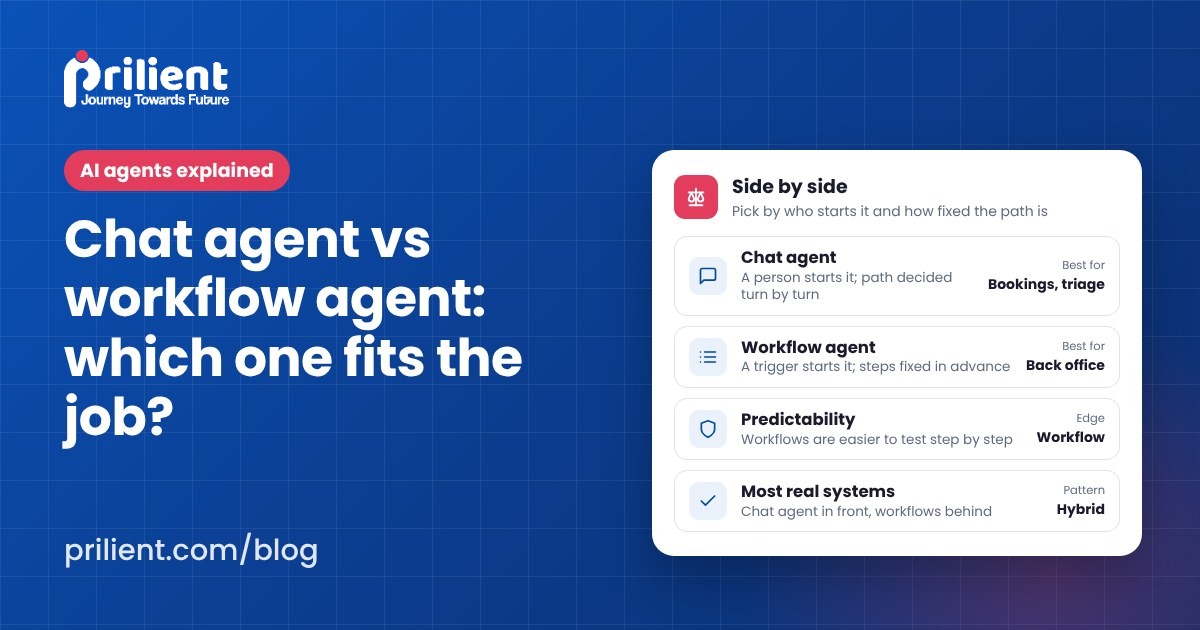
Two words that get used loosely
"Agent" now covers almost anything with an AI model inside it. A useful distinction comes from Anthropic's guide Building effective agents: workflows are systems where models and tools are orchestrated through predefined code paths, while agents are systems where the model dynamically directs its own process and tool use.
In practice, buyers meet these two patterns as:
- Chat agents: an AI receptionist on the phone, a WhatsApp assistant, a support bot on a website. The person leads; the agent responds, asks questions and uses tools as needed.
- Workflow agents: an invoice-processing pipeline, a lead-enrichment job, a nightly report. A trigger starts it; it runs its steps; it hands results to a system or a person.
If you want the wider comparison with plain chatbots and rule-based automation, see AI agent vs chatbot vs workflow automation.
How each one works
A chat agent keeps a conversation going. On each turn it reads what the person said, decides whether to answer, ask a question or use a tool (look up an order, book a slot, create a ticket) and replies. Its path is different in every conversation.
A workflow agent follows a fixed route. For example: receive an invoice, extract the fields, check them against the purchase order, post to the accounting system, and send exceptions to a person. The model might do the extraction and the matching, but the order of the steps never changes.
Side by side
| Chat agent | Workflow agent | |
|---|---|---|
| Started by | A person (call, message, chat) | A trigger (new email, file, form, schedule) |
| Path | Decided turn by turn | Fixed in advance |
| Best at | Questions, bookings, triage, qualification | Repeatable back-office tasks at volume |
| Predictability | Lower; needs guardrails and testing | Higher; each step can be tested alone |
| Typical failure | Goes off-topic, misunderstands, loops | Breaks on inputs it was not built for |
| How people stay in control | Handoff to staff when unsure or when asked | Exception queue and approval steps |
| How you measure it | Resolution rate, handoff rate, customer satisfaction | Throughput, error rate, exceptions per 100 items |
When to choose a chat agent
- The person's need is not known until they say it.
- The job involves questions back and forth: qualifying a lead, booking an appointment, answering policy questions.
- Speed of response matters, for example after-hours calls or WhatsApp enquiries.
Examples: an AI voice agent that answers a clinic's phone, or a WhatsApp AI chatbot that qualifies property enquiries.
When to choose a workflow agent
- The steps are the same every time and can be written down.
- Volume is high and errors are costly.
- An audit trail of each step is needed.
Examples: extracting data from invoices and forms with document AI, or enriching and routing leads with AI workflow automation.
The hybrid most businesses end up with
Real systems mix the two. A chat agent on WhatsApp takes a customer's request, then hands a structured job to a workflow: create the order, check stock, send the confirmation. The chat side stays flexible; the workflow side stays predictable and testable.
This split also makes systems safer. The chat agent can only start approved workflows with checked inputs, instead of calling every system directly.
A five-question checklist
- Can you write the steps down in order? If yes, start with a workflow.
- Does a person need to explain their need? If yes, you need a chat agent at the front.
- What happens when it is wrong? The higher the cost, the more you want workflow steps with checks and approvals.
- How much volume is there? High volume favours workflows; a chat agent is worth it where response time matters.
- Who takes over when it is unsure? Name the person or queue before you build either one.
How Prilient builds both
Prilient builds chat agents for phone, WhatsApp and web, and workflow agents for documents, leads and back-office tasks, often in the same project. See our AI agent development work or the six ready-made Prilient AI Agents. Prilient has completed 500+ projects for 50+ clients since 2019.
Book a free 30-minute call and describe one task. We will tell you which pattern fits.
Questions about chat agents and workflow agents
What is the difference between a chat agent and a workflow agent?
A chat agent decides its next step from a conversation with a person. A workflow agent follows a fixed sequence of steps started by a trigger, with AI used inside some steps.
Is a workflow agent the same as automation?
Close, but not the same. Classic automation follows fixed rules only. A workflow agent keeps the fixed sequence but uses AI in steps that need judgement, such as reading a document or classifying a request.
Which is more reliable?
Workflow agents are more predictable because each step can be tested on its own. Chat agents need more guardrails, testing on real conversations and a clear handoff to staff.
Can one system use both?
Yes, and most good systems do. A chat agent handles the conversation and hands structured jobs to workflows that do the back-office work.
Which should a small business start with?
Start where the pain is. If calls and messages go unanswered, start with a chat agent. If staff spend hours on repetitive data entry, start with a workflow.
Leave A Reply
Your email address will not be published. Required fields are marked *