
Why the first 30 days matter
Most companies that hire an AI consultant are not short of ideas. They are short of certainty: which idea will work on their data, what it will cost to run, and what could go wrong. The first month is where an engagement either answers those questions or turns into a slide deck.
The plan below is how we structure AI consulting at Prilient. You can also use it as a yardstick for any proposal you receive.
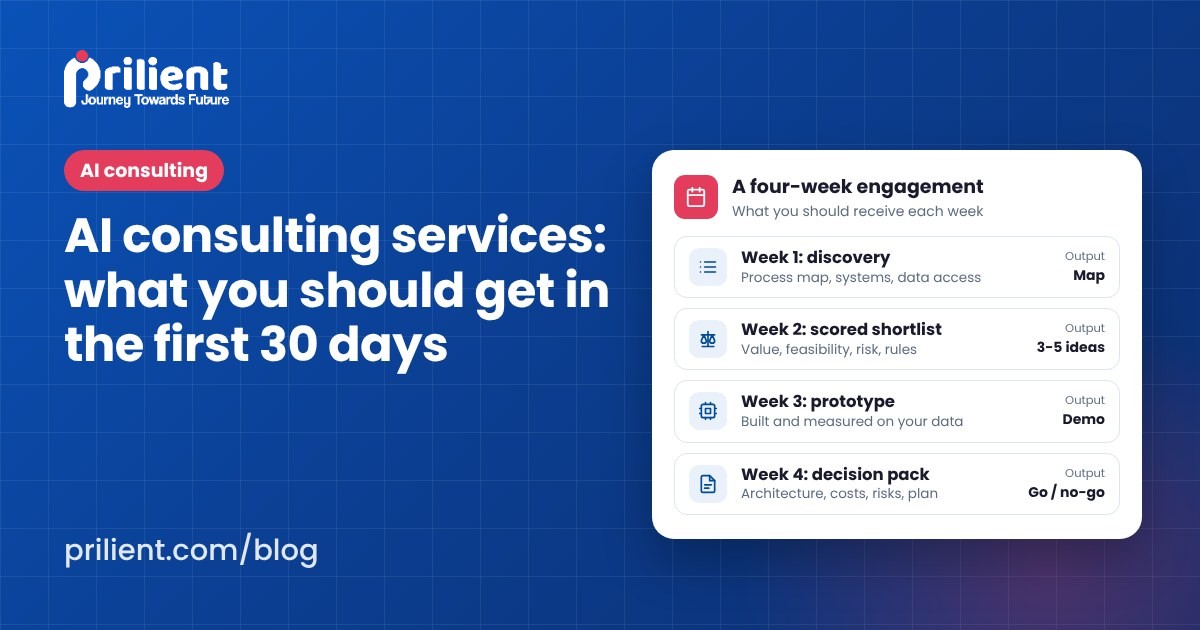
Week 1: discovery
The consultant should spend this week with the people who do the work, not only with leadership.
What happens
- Interviews with the teams that handle calls, emails, documents, orders, tickets and reports.
- A process inventory: each repetitive task, how often it happens, how long it takes and who does it.
- A data and systems check: where the data lives, whether there is an API, who owns access, and what is personal or regulated.
What you should receive
- A one-page process map with volumes and time spent.
- A list of systems and data sources, with access notes.
- Early red flags, such as data that cannot leave a region or a system with no API.
Week 2: a scored shortlist of use cases
Ideas are scored, not ranked by enthusiasm. A simple, honest scoring model looks at:
| Factor | Question it answers |
|---|---|
| Value | How many hours or how much revenue does it touch each month? |
| Feasibility | Is the data available and good enough? Is there an API? |
| Risk | What happens when the AI is wrong? Who checks it? |
| Time to first result | Can a pilot show results within weeks, not quarters? |
| Fit with rules | Does it involve hiring, credit, health or other regulated decisions? |
What you should receive: a shortlist of three to five use cases with scores and the reasoning, and one recommended first project.
Regulated areas need extra care. If a use case screens job candidates or makes decisions about customers, the consultant should flag rules such as the EU AI Act or the California and Colorado rules before anything is built.
Week 3: a prototype on your data
This is the week that separates consulting from advice. The best use case is built as a small, working prototype on a sample of your real data: real invoices, real call recordings, real tickets.
What you should receive
- A working prototype you can try yourself.
- Measured results on your sample: how often it was right, where it failed and why.
- An honest note on what would need to change for production.
A prototype that only works on clean demo data tells you very little. Insist on your own messy data.
Week 4: the decision pack
What you should receive
- Architecture: which models, which systems it connects to, where data is stored and who can see it.
- Costs: the one-time build and the monthly running cost (model usage, hosting, support), with the assumptions written down.
- Risks and controls: what happens when the AI is unsure, where a person signs off, and how errors are caught.
- A delivery plan: phases, owners on your side, and what "done" means for each phase.
- A go or no-go recommendation, including "not yet" if the data or process is not ready.
Red flags in an AI consulting proposal
- No prototype, only workshops and reports.
- A fixed technology choice before anyone has seen your data.
- No running-cost estimate, only a build price.
- No mention of where data is stored or who can access it.
- No named person who will do the technical work.
- Claims of results from other clients that you cannot check.
When you don't need an AI consultant
If you already know the use case, have the data ready and only need it built, skip consulting and go straight to a scoped build with an AI agent development team. A short paid discovery is still worth it for anything that touches customers or regulated decisions.
How Prilient runs AI consulting
Prilient is an AI agent development company with its engineering team in Jaipur, India, working with clients worldwide. Our consultants are the same engineers who build the systems, so the plan you get is one we would be willing to deliver. We have completed 500+ projects for 50+ clients since 2019.
Book a free 30-minute call and bring one process you would like to fix. We will tell you whether AI is the right tool for it.
Questions about AI consulting services
What do AI consulting services include?
Discovery of your processes and data, a scored shortlist of AI use cases, a prototype of the best one on your own data, and a decision pack with architecture, running costs, risks and a delivery plan.
How long should an AI consulting engagement take?
For a single business area, about four weeks is enough to reach a tested prototype and a build plan. Company-wide strategy work takes longer, but each area should still end with something tested.
What is the difference between an AI consultant and an AI development company?
A consultant helps you decide what to build. A development company builds and runs it. The best results come when the people who advise are the people who will build, so the plan is realistic.
How do I measure whether AI consulting worked?
By what you can test at the end: a prototype on your data with measured accuracy, a running-cost estimate with its assumptions, and a clear go or no-go decision.
Do we need clean data before hiring an AI consultant?
No. Part of the consultant's job in the first two weeks is to check what data you have and whether it is good enough. Messy data is normal and is better found early.
Can Prilient work with companies outside India?
Yes. Prilient works with clients worldwide from its team in Jaipur, with meetings scheduled in your time zone.
Leave A Reply
Your email address will not be published. Required fields are marked *