
What the Model Context Protocol is
The Model Context Protocol (MCP) is an open standard for connecting AI applications to external systems. Anthropic introduced it in late 2024, and on 9 December 2025 donated it to the Agentic AI Foundation, a fund under the Linux Foundation co-founded by Anthropic, Block and OpenAI. By then the Linux Foundation counted more than 10,000 published MCP servers.
In MCP terms there are three roles:
- Host: the AI application a person uses, such as an AI assistant or an IDE.
- Client: the connector inside the host that talks to one server.
- Server: the service you build. It exposes your system as tools (actions such as "create invoice"), resources (data the model can read) and prompts (ready-made instructions).
Build one MCP server and every MCP-compatible client can use it. That is the whole appeal: one integration instead of one per AI vendor.
When you need an MCP server (and when you don't)
You probably need one when:
- Your customers ask for it. SaaS buyers increasingly want to use your product from inside the AI tools they already work in. An MCP server is now the expected way to offer that.
- You are building agents that act across your systems. An agent that reads the CRM, checks stock in the ERP and raises a ticket is easier to build and govern when each system sits behind an MCP server with clear permissions.
- Several teams want AI access to the same system. One well-governed server beats five scripts with five sets of credentials.
You probably don't need one when a single, fixed workflow calls one API. A plain integration or an AI workflow automation is simpler, cheaper and easier to test.
What building a production MCP server involves
A demo server can be written in an afternoon with the official SDKs. A server that customers or staff rely on involves more:
| Step | What it covers |
|---|---|
| Tool design | Choosing a small set of clear, well-described tools. Models pick tools by their names and descriptions, so this is closer to product design than to API mapping. |
| Authentication | Local servers run beside the client; remote servers need sign-in. MCP's authorization framework is based on OAuth 2.1, so each user acts with their own permissions. |
| Transport and hosting | Local servers use stdio. Remote servers use Streamable HTTP, which replaced the older HTTP+SSE transport. |
| Safety on write actions | Confirmation steps, limits and dry-run modes for anything that changes data or spends money. |
| Logging and audit | A record of which user, through which client, called which tool with which inputs. |
| Testing with real clients | Checking that the main AI clients pick the right tools and recover from errors. |
| Versioning | Keeping up with the specification as it changes. |
The last point matters now. The 2026-07-28 revision of the specification made MCP stateless at the protocol layer: each request carries its own protocol version, client identity and capabilities, and protocol-level sessions were removed from Streamable HTTP. Servers built for earlier revisions keep working with older clients, but a server you build today should plan for the new model.
What drives the cost and timeline
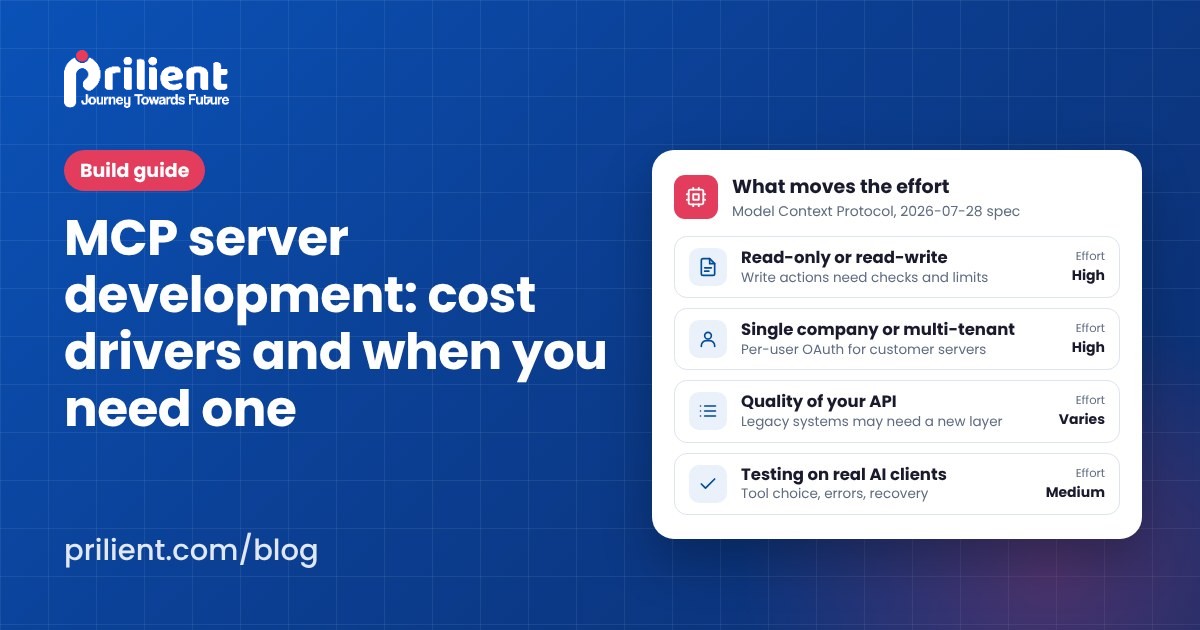
We are not putting a price on it here, because two MCP servers with the same number of tools can differ several times over in effort. These are the factors that move it:
- Read-only or read-write. A server that only reads data is far simpler than one that creates, updates or deletes records. Write actions need confirmations, permission checks and careful error handling.
- Single company or multi-tenant. A server for your own staff can use one identity provider. A server you offer to every customer must keep each tenant's data apart, with per-user OAuth.
- The quality of the underlying API. A well-documented REST API with clean auth is quick to wrap. A legacy system with no API may need a new service layer first.
- Number and design of tools. Fewer, well-designed tools usually work better with models than one tool per endpoint.
- Compliance needs. Health, finance or personal data adds data-handling rules, audit trails and sometimes hosting constraints.
- Testing depth. Each AI client behaves a little differently. Testing on the clients your users actually use is real work, and worth it.
As a rough guide, a read-only server over one well-documented API is a matter of days. A remote, multi-tenant server with OAuth, write actions and audit logging is a multi-week project. Ongoing maintenance follows the specification and the clients your users adopt.
Build it yourself or bring in a team?
Build it in-house if your engineers know the underlying system well and the server is read-only or internal. The SDKs are good, and the protocol is well documented.
Bring in help when the server is customer-facing, multi-tenant or handles write actions, or when your team has not yet shipped OAuth-based integrations. That is the part where mistakes are expensive. Prilient builds MCP servers and connects them to production agents as part of its AI integration and MLOps work, and the same team builds the AI agents that use them.
A short checklist before you start
- Write down the five to ten jobs users will do through AI, in plain language.
- Map each job to one tool. Merge or drop tools that overlap.
- Decide who the user is in each call, and what they may see and change.
- Choose local, remote or both.
- Plan logging, rate limits and confirmations for every write action.
- Pick the AI clients you will test on.
If you want a second opinion on the plan, book a free 30-minute call with Prilient. We have delivered 500+ projects for 50+ clients since 2019, and we will tell you plainly whether you need an MCP server or a simpler integration.
Questions about MCP server development
What is an MCP server?
A service that exposes a system's actions, data and ready-made prompts to AI applications through the Model Context Protocol, so any MCP-compatible AI client can use it without a custom integration.
Is MCP an open standard?
Yes. Anthropic introduced it in late 2024 and donated it in December 2025 to the Agentic AI Foundation under the Linux Foundation, which Anthropic, Block and OpenAI co-founded.
How long does it take to build an MCP server?
A read-only server over one well-documented API can take days. A remote, multi-tenant server with OAuth, write actions and audit logging usually takes several weeks, mostly for security and testing.
Do I need OAuth for my MCP server?
For a local server running beside the client, usually not. For a remote server that real users sign in to, yes: MCP's authorization framework is based on OAuth 2.1, so each user acts with their own permissions.
What changed in the 2026-07-28 MCP specification?
MCP became stateless at the protocol layer. Each request carries its protocol version, client identity and capabilities, and protocol-level sessions were removed from the Streamable HTTP transport, which makes servers easier to run behind ordinary load balancers.
Can Prilient build an MCP server for our product?
Yes. Prilient designs, builds and tests MCP servers for products and internal systems, and connects them to production AI agents.
Leave A Reply
Your email address will not be published. Required fields are marked *