
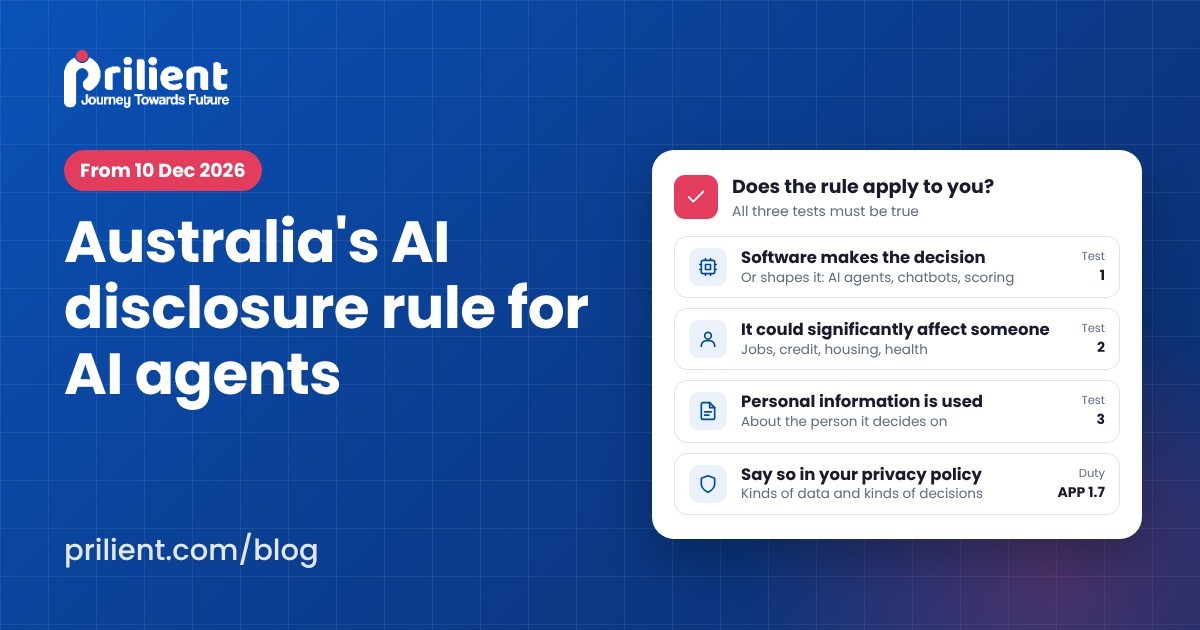
Australia's first tranche of privacy reform, the Privacy and Other Legislation Amendment Act 2024, added three new paragraphs to Australian Privacy Principle 1: APP 1.7, 1.8 and 1.9. They start on 10 December 2026, and they apply to decisions made from that date even if the personal information was collected earlier (G+T). The Office of the Australian Information Commissioner (OAIC) published its final guidance, a fact sheet and a flowchart on 30 September 2026 (OAIC). If you run an AI receptionist, an interview-screening agent or a collections agent for Australian customers or staff, this guide explains what counts, what to write and what to ask your vendor. It is a plain-English summary, not legal advice.
What the rule says
The obligation applies when all three of these are true, according to the OAIC fact sheet:
- Your business has arranged for a computer program to make a decision, or to do something substantially and directly related to making one.
- The decision could reasonably be expected to significantly affect a person's rights or interests.
- Personal information about that person is used to run the program for that decision.
When all three apply, your privacy policy must state:
- the kinds of personal information used by those programs;
- the kinds of decisions made solely by the programs; and
- the kinds of decisions where the programs do something substantially and directly related to the decision.
A "decision" includes refusing or failing to decide, so an agent that declines a request is making one. The rule is about transparency only. It does not give people a new right to challenge a decision, and it does not require you to notify each person directly (Allens).
Who has to comply
The rule applies to APP entities. Most businesses covered by the Privacy Act have annual turnover above A$3 million. Some smaller businesses are covered too, including certain health service providers, businesses that trade in personal information, Commonwealth contracted service providers, credit reporting bodies and businesses that have opted in (Sprintlaw). A small dental practice or physiotherapy clinic can therefore be in scope.
If you are based outside Australia and serve Australian customers, ask your lawyer whether the Privacy Act covers you before deciding the rule is not yours.
Do AI chatbots and AI agents count?
Yes. The OAIC reads "computer program" broadly. Its guidance covers rule-based tools, machine learning, generative AI and chatbots, and even everyday software such as spreadsheets (Corrs).
Having a person check the output does not take a tool out of scope. The fact sheet says machine learning or generative AI outputs used for significant decisions are generally in scope unless they are "subject to extensive human oversight and control". Allens lists what the OAIC looks at: how much staff rely on the output, how often they override it, whether it advises or decides, and how well it can be explained.
"Significantly affect" covers rights and interests such as health, housing, finance, employment and access to utilities. The OAIC's examples include recruitment software that sorts candidates, approving or rejecting loan or credit applications, assessing insurance eligibility, personalised pricing of significant goods, and facial recognition used for watchlists in shops or stadiums.
Which AI agent jobs are likely in scope
How this applies to common AI agents, based on the OAIC's examples. Your own answer depends on how each agent is set up.
| Agent job | Likely in scope? | Why |
|---|---|---|
| Interview screening that scores or shortlists candidates | Likely yes | Recruitment software that sorts candidates is one of the OAIC's own examples, and employment is a listed interest |
| Debt collection or payment reminders that decide who is offered a payment plan or escalated | Likely yes, where it shapes credit or account outcomes | Finance is a listed interest; refusing an option is a decision |
| Customer support that answers questions | Usually not | In scope if it can refuse refunds, suspend accounts or change prices for a person |
| Receptionist or appointment setter that books slots | Usually not | In scope if it triages who is seen first in a health setting, or refuses bookings |
| WhatsApp or web lead qualification | Usually not | In scope if it sets personalised prices for significant goods or screens people out of a service |
| Face-recognition attendance or access control | Check carefully | Uses biometric data, which the guidance says to call out clearly; in scope where it affects pay or access to work |
Your vendor does not carry the duty for you
Using third-party software "does not transfer the disclosure obligation to the third-party vendor", even where you cannot change how the tool works (Corrs). The fact sheet says a business that buys software has still "arranged for" it, and expects vendors to give clear, high-level information on how their software can be used to make decisions.
Ask every AI vendor these six questions before 10 December:
- Which decisions can your tool make on its own, and which does it inform?
- Which kinds of personal information does it use for each decision?
- Does it use any sensitive information, such as health or biometric data?
- What can our staff see and override, and is each override logged?
- Will you give us a written description we can use in our privacy policy?
- Will you tell us before an update changes what the tool decides or the data it uses?
A seven-step checklist before 10 December
- List every program that touches decisions about people. Include AI agents, chatbots, vendor features switched on inside your CRM or HR system, and spreadsheets with scoring rules. Hamilton Locke warns that automation often arrives "incrementally or through software updates" (Hamilton Locke).
- Apply the three tests to each one. Write down why it is in or out of scope.
- Map the personal information each uses. Name sensitive information, such as health or biometric data, separately.
- Record how people use the output. Note who reviews it, how often they disagree with it, and how reasons are recorded.
- Get the vendor's answers in writing. Use the six questions above and add them to the contract where you can.
- Write a specific privacy policy section. Corrs warns that "generic, high-level transparency statements will not be sufficient". You may group similar decisions, but keep separate processes separate.
- Set a review trigger. Re-check the policy whenever you add an agent or change what one does, rather than "set and forget".
An illustrative privacy policy entry for an interview-screening agent: "We use an automated screening tool to sort and score job applications. It uses the information in your application and your answers to our screening questions. A recruiter reviews every shortlist before anyone is invited to interview or turned down." Adapt it to what your tool does, and have your lawyer check it.
What happens if you miss the date
The OAIC is already reviewing privacy policies. It began a sweep of about 60 organisations on 1 January 2026, and it can issue infringement notices of up to A$330,000 to a company that fails to keep a current, comprehensive and easily accessible privacy policy, according to Herbert Smith Freehills Kramer (JD Supra). Corrs also points to a second tranche of reform that may widen the definition of personal information and bring more programs into scope.
How Prilient can help
Prilient builds custom AI agents and runs six ready-made Prilient AI Agents: Receptionist, Customer Support, WhatsApp Lead Generation, Appointment Setter, Debt Collection and HR Interview Screening. Since 2019 the team has delivered 500+ projects for 50+ clients. If you use AI voice agents or plan to, the time to decide what each agent may decide on its own is before it goes live.
Book a free 30-minute call. We will go through the agents you run or plan against the three tests, and list the questions to put to your vendor and your lawyer.
Questions about Australia's automated decision rule
When does Australia's automated decision-making disclosure rule start?
On 10 December 2026. From that date, APP entities must describe in their privacy policy the kinds of personal information and decisions involved when a computer program makes or substantially shapes decisions that could significantly affect people.
Does an AI chatbot count as a computer program under the Privacy Act?
Yes. The OAIC's guidance reads the term broadly. It covers rule-based tools, machine learning, generative AI and chatbots, and even spreadsheets.
Does a human reviewing the AI's output take it out of scope?
Usually not. Outputs used for significant decisions are generally in scope unless they are subject to extensive human oversight and control. The OAIC looks at how much staff rely on the output and how often they override it.
Our AI tool comes from a vendor. Who has to disclose it?
You do. Buying third-party software does not move the obligation to the vendor, even if you cannot change how the tool works. Ask the vendor for a written description you can use.
Do small businesses have to comply?
Generally only businesses with annual turnover above A$3 million. Some smaller ones are covered too, including certain health service providers, businesses that trade in personal information and Commonwealth contracted service providers.
Do we have to tell each customer or let them challenge the decision?
No. The rule requires disclosure in your privacy policy. It does not require notice to each person and does not create a new right to contest a decision.
Leave A Reply
Your email address will not be published. Required fields are marked *